CLYNGAS is an innovative project that will replace part of the fuel used to manufacture clinker with a high-value gas obtained through the gasification process of waste and by-products from other industries.
This technology will improve the ability of using waste-derived fuel, replacing part of the fossil fuels and avoiding around 5,5% of greenhouse gas (GHG) emissions, while guaranteeing a stable process and high quality production.
This project, which is being carried out at the Cemex cement plant in Alicante (Spain), is a relevant part of Cemex‘s ‘Future in Action’ strategy and roadmap to achieve carbon neutrality by 2050.

Project phases
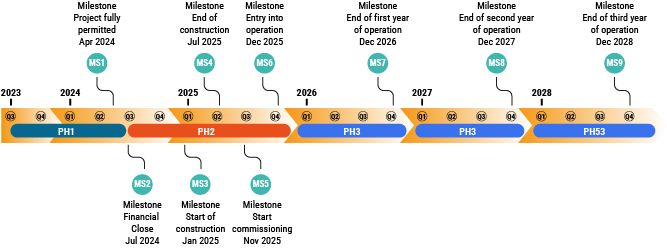
- Phase 1: Financing and launching of the project. This first phase will last for one year and will involve the actual financing, the development of the detailed design of the plant and the obtaining of the necessary permits and agreements for the construction phase.
- Phase 2: Construction and training. Over a year and a half (2024-2025) the plant will be built and all the tests necessary for its implementation and operation will be carried out.
- Phase 3: Operation. Start-up of the plant for three years (2026-2028) for manufacturing and commercial operation.
Benefits
- Reduction of emissions: CLYNGAS will enable a significant reduction in greenhouse gas (GHG) emissions, estimated at 406,960 tonnes of CO2 equivalent during the first ten years of the project’s life.
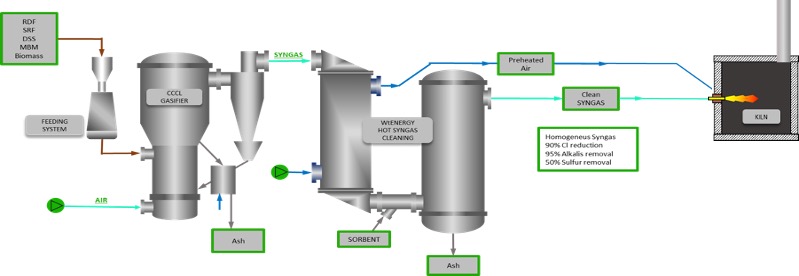
- Pioneering technology: CLYNGAS uses an innovative cleantech technology developed by WtEnergy that converts non-recyclable waste and biomass into clean energy.
- Energy Efficiency: The application of this technological innovation improves energy efficiency and generates significant savings that have an impact on production costs through the use of clean energy.
- Substitution of fossil fuels: It replaces petroleum coke in the cement industry with synthesis gas (syngas) generated from fuels derived from waste. This waste can come from the kiln itself or from waste and by-products from other industries, providing an energy recovery of Solid Recovered Fuel (SRF) and thus avoiding its deposit in landfills and the associated emissions.

- Replicability: This technology can be used in other cement plants and in other industries or sectors, extending the positive impact and reduction of the carbon footprint.
- Circular economy: CLYNGAS is focused on the production and use of syngas from organic solid waste (OSW). The use of this waste helps to reduce the use of fossil fuels, to reduce the associated CO2 emissions and to eliminate them by introducing them into the circular economy. In this way, it contributes to solving the environmental problem of landfills, offering a positive response to social and regulatory demands and enabling the production of low-carbon materials for sustainable construction.
- Sustainability: The final product will be much more sustainable, as CLYNGAS offers a solution by transforming waste into clean energy, with a lower carbon footprint, and contributing to more sustainable and efficient construction. This not only aligns with the sector’s decarbonisation commitments, but also responds to societal and regulatory demands: more sustainable, efficient, resilient, durable, accessible and inclusive cities. If building materials are more sustainable, buildings will be more sustainable and contribute to the overall reduction of CO2 emissions.
Tecnology
WtEnergy is the technology partner and provider of Clyngas project.
Waste to Energy Advanced Solutions (“WtEnergy”) is a clean energy startup that has developed a novel process to transform solid waste into synthesis gas for industrial purposes. WtEnergy converts biomass and non-recyclable waste into a clean energy solution that can be used in the short term as an alternative to fossil fuels.